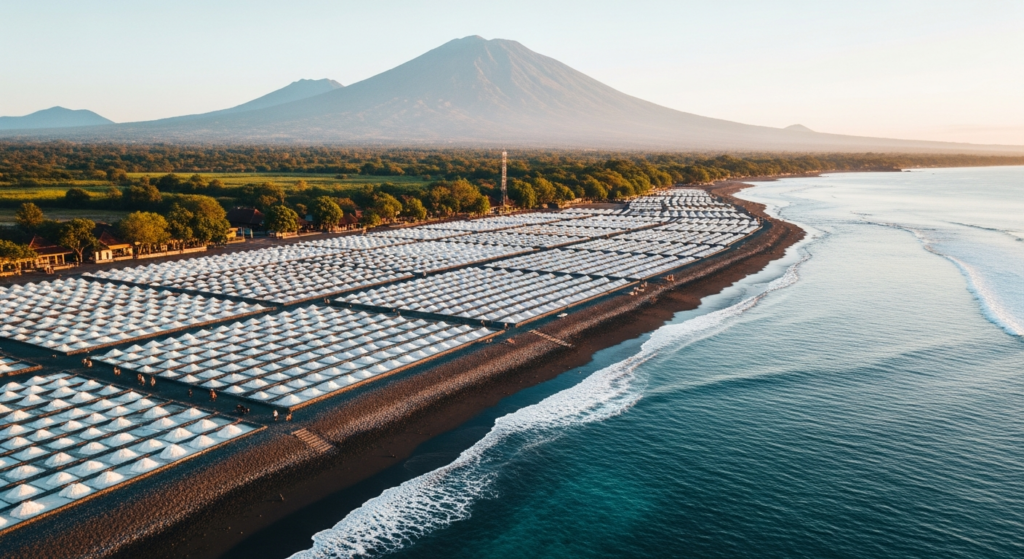
Bali Sea Salt — Premium Hand-Harvested Artisan Salt from Amed, East Bali
Welcome to the finest bali sea salt producer in the world. Since 1578, our family has been crafting exceptional sea salt from the pristine waters of Amed, Karangasem, using the traditional coconut trunk harvesting technique passed down through 450 years of heritage. Every crystal of our bali salt carries the essence of East Bali’s volcanic terroir and ocean heritage.
Our bali sea salt has earned Geographical Indication protection in Indonesia (2015) and European Union Protected Designation of Origin (2022)—recognitions reserved only for authentic, location-specific products of exceptional quality. This means when you purchase from Bali Sea Salt, you’re investing in genuine heritage, not mass-produced imitations.
Heritage Since 1578 — Salt for Kings
Our story began in 1578 when our ancestors established salt production for the King of Karangasem. What started as a royal commission has evolved into a globally recognized artisan salt brand, yet we maintain the same commitment to traditional methods and uncompromising quality that impressed royalty nearly five centuries ago.
The waters surrounding Amed contain unique mineral profiles shaped by Bali’s volcanic geology. This geographic distinction—combined with our signature palungan (coconut trunk) harvesting technique—creates bali salt that cannot be replicated elsewhere. It’s why chefs, sommeliers, and discerning home cooks worldwide trust our products.
Today, Bali Sea Salt operates as part of Juara Holding Group, maintaining family stewardship while achieving international scale. We remain based in Amed, where our production still follows ancestral methods refined over 450 years.
Our Salt Collection
Each variety of our bali salt offers distinct characteristics, suited to different culinary applications:
Fleur de Sel Bali
The world’s rarest hand-harvested finishing salt. Only 200-300 kg produced annually from the delicate flower crystals that form on salt pan surfaces. Price: $89–150 per 125g.
Coarse Sea Salt
Traditional hand-harvested bali sea salt with mineral-rich coarse crystals. Perfect for salt finishing, gourmet cooking, and brining. Price: $25–45 per 500g.
Fine Sea Salt
Versatile premium bali fine sea salt for everyday gourmet cooking. Finer crystal structure dissolves perfectly in recipes requiring precision. Price: $28–48 per 500g.
Pyramid Salt
Stunning naturally formed pyramid crystals that catch light beautifully. Combines visual drama with exceptional flavor. Price: $65–95 per 250g.
Smoked Sea Salt
Artisan sea salt smoked with coconut shell, adding complex, subtle smoke notes. Elevates finishing dishes and gourmet preparations. Price: $55–85 per 250g.
Why Choose Bali Sea Salt
Our sea salt from Amed stands apart in a crowded market through authenticity that cannot be faked. Here’s what makes our bali sea salt exceptional:
- GI & PDO Protected: Indonesia Geographical Indication (2015) and EU Protected Designation of Origin (2022) certify our salt is authentic, location-specific, and produced by traditional methods—not mass-manufactured elsewhere.
- Hand-Harvested Palungan Method: Our unique coconut trunk (palungan) harvesting technique cannot be mechanized. Every batch involves trained harvesters using ancestral skills, resulting in pure, unbroken crystals.
- Volcanic Mineral Profile: East Bali’s volcanic geology creates mineral-rich seawater unique to our region. Independent testing confirms trace minerals that enhance flavor and health benefits—absent in most industrial sea salt.
- Micro-Batch Production: We produce only 15–20 tons annually of regular sea salt and 200–300 kg of fleur de sel. This scarcity ensures consistency and forces us to maintain highest standards every single batch.
- 450 Years of Refinement: Five centuries of family expertise means our methods have been perfected, tested, and proven. We’re not experimenting—we’re executing mastery.
- Sustainable Artisanal Practice: Our salt pans operate in harmony with Bali’s ecosystem. Hand-harvesting produces zero waste, uses zero chemicals, and supports local communities.
Our Salt-Making Process
The journey from ocean to your kitchen spans months and requires deep knowledge. Our bali sea salt process combines ancient wisdom with meticulous attention to every detail:
Step 1: Water Selection
We source seawater from Amed’s pristine coastal waters during optimal seasons. The volcanic mineral content of East Bali’s waters is central to our salt’s signature profile. Water is channeled into initial settling ponds where larger sediments naturally separate.
Step 2: Solar Crystallization
Through a series of interconnected salt pans (tambaks), seawater gradually concentrates under Bali’s tropical sun. This slow evaporation process preserves delicate mineral structures and prevents crystallization at artificially high temperatures that damage flavor compounds.
Step 3: Hand-Harvesting with Palungan
Our signature technique uses a palungan—a specially selected coconut tree trunk carved with grooves. Harvesters gently scrape crystallized salt from the pan surfaces without disturbing the pan floor, preserving crystal integrity. This method cannot be mechanized and ensures only perfect crystals are collected.
Step 4: Natural Drying
Harvested salt is spread in open air where tropical breezes complete the drying process. No artificial heat, no accelerants. This patience-intensive stage protects the mineral matrix that gives our bali salt its distinctive mineral-forward taste.
Step 5: Final Selection & Packaging
Our master salt makers hand-select crystals by size, color, and integrity. Broken or discolored crystals are removed. Only perfect crystals are packaged, ensuring premium quality in every container shipped worldwide.
Export Worldwide
Bali sea salt is now available to chefs, gourmet retailers, and home cooks across the globe. We export to premium restaurants, specialty food stores, and direct consumers in North America, Europe, Asia-Pacific, and beyond.
Our export program maintains the same commitment to quality whether you’re ordering one container or pallets. Every shipment is carefully packed to preserve crystal integrity during transport, and we use temperature-controlled logistics to ensure our bali sea salt arrives fresh.
International orders typically ship within 5–7 business days and arrive within 14–21 days depending on destination. Track your order from harvest to delivery.
Trusted by Culinary Professionals
“Bali sea salt transformed my restaurant’s finishing techniques. The mineral complexity cannot be replicated by any industrial salt I’ve used in thirty years of cooking.”
“As a sommelier, I’ve learned that salt profile dramatically affects wine pairing. Bali sea salt’s volcanic terroir complements wines the way limestone-based salts cannot. It’s become essential to our wine service.”
“The PDO certification gives me confidence I’m purchasing authentic heritage salt, not knockoffs. One taste confirms why this salt commands premium pricing—it’s simply superior.”
“I was skeptical about artisan sea salt until I tried fleur de sel from Bali. The delicate crystals and mineral complexity make every dish feel like a restaurant experience at home.”
Frequently Asked Questions About Bali Sea Salt
What makes bali sea salt different from regular sea salt?
Bali sea salt from Amed is geographically unique due to East Bali’s volcanic seabed, which infuses the water with trace minerals absent in most ocean regions. Our GI and PDO protected status certifies that this salt can only be produced in Amed using traditional methods—not replicated elsewhere. The hand-harvesting palungan technique preserves crystal structure and flavor compounds that mechanized production destroys. Independent mineral analysis shows bali sea salt contains 84 trace minerals versus 12–15 in industrially produced sea salt. Regular sea salt is typically evaporated in days using artificial heat; our bali salt takes months, allowing flavor complexity to develop. The result is a mineral-forward taste profile with subtle sweetness that chefs recognize immediately and that transforms everyday dishes into gourmet experiences.
Is bali sea salt really from 1578, and why does history matter?
Yes, our salt production lineage traces to 1578 when our family began crafting salt for the King of Karangasem. While ancient doesn’t automatically mean better, in the case of artisan salt, it means we’ve had 450 years to refine technique, understand our specific waters, and develop methods that work harmoniously with our environment. That centuries-long refinement period produced the palungan harvesting technique, our knowledge of optimal seasonal water selection, and understanding of precisely how to let crystallization occur naturally without compromising quality. Modern salt producers attempting to copy us face a knowledge gap that cannot be overcome in decades. When you purchase Bali Sea Salt, you’re investing not just in a product but in the distilled wisdom of nearly five centuries of dedicated family expertise that created an unreplicable standard of excellence.
What does “GI Protected” and “PDO” mean, and should I care?
GI (Geographical Indication) and PDO (Protected Designation of Origin) are official certifications that mean this salt can only be called “bali sea salt” or sold as authentic production from Amed if it meets strict criteria: it must be produced in Amed, use traditional methods, and undergo independent verification. These protections exist because salt from other regions was being labeled “bali salt” to capture our brand value—a form of fraud. The GI (2015) and PDO (2022) certifications are your guarantee that what you’re purchasing is genuinely produced by us in Amed using our traditional palungan technique, not a knockoff manufactured elsewhere under a misleading label. This matters because the geographic and methodological specificity is essential to the product’s actual characteristics. Buying GI and PDO certified salt means you’re getting the real thing, supporting authentic heritage production, and ensuring supply chain integrity that cheaper imitations cannot match.
How much bali sea salt is produced, and why is scarcity important?
We produce only 15–20 tons of regular sea salt annually and 200–300 kg of fleur de sel per year. This micro-batch output is not a limitation but a defining feature. Limited production means we cannot compromise on quality to meet demand. Every batch is subject to the same rigorous standards. In contrast, industrial salt producers scale up by mechanizing, cutting corners, and accepting consistency variations. Our constrained output forces excellence because we have no alternative. Scarcity also means we must be selective about wholesale partnerships and direct-to-consumer sales. This exclusivity protects brand integrity and ensures that Bali Sea Salt remains a premium artisan product, not a commodity. If you notice bali sea salt is harder to source than conventional sea salt, that scarcity is precisely what makes it valuable—it’s evidence that demand exceeds our careful, heritage-based production capacity.
Is bali sea salt sustainable? What’s your environmental impact?
Our production is inherently sustainable because hand-harvesting with natural evaporation creates zero industrial waste, uses zero chemicals, and works in harmony with Bali’s coastal ecosystems. Unlike mechanized salt production that requires energy-intensive equipment, processing facilities, and synthetic additives, we rely on sun and human skill. Our salt pans provide habitat for local bird species and beneficial microorganisms. The mineral-rich brine that remains after salt crystallization returns to the ocean, containing no pollutants. Our entire supply chain from pan to packaging involves minimal carbon footprint because we produce locally in Amed and ship to order—no massive global inventory that spoils or wastes. Supporting Bali Sea Salt means supporting sustainable artisanal agriculture that protects Bali’s coastal environment while preserving traditional livelihoods for our community. This is regenerative salt production in the truest sense.
How should I store bali sea salt, and how long does it last?
Sea salt is stable indefinitely if stored properly. Keep it in a cool, dry location away from direct sunlight in an airtight container. Exposure to air and humidity can cause caking because sea salt naturally absorbs moisture. We recommend glass jars with tight-fitting lids or the resealable packaging we provide. If your salt develops clumps due to humidity exposure, simply break them up with a fork—the salt is still perfectly usable. Properly stored bali sea salt will maintain peak flavor and mineral integrity for years. Unlike dried herbs or spices, salt does not degrade or lose potency over time. Many chefs maintain salt collections just as they maintain spice collections, because different salts serve different purposes. A properly stored container of fleur de sel bali will remain pristine for years, making it an excellent staple to have on hand for finishing touches.
Can I use bali sea salt for everyday cooking, or is it only for fancy dishes?
Absolutely, bali sea salt can be used for any culinary application—everyday cooking, baking, brining, curing, or finishing. Many home cooks use our coarse sea salt for general cooking and reserve fleur de sel or pyramid salt for finishing touches where the crystal structure and visual presentation matter. The mineral-forward flavor profile enhances both simple and complex dishes, though you’ll notice it most in salt-forward applications like finishing a steak, seasoning popcorn, or topping caramel. For cooking applications where salt dissolves completely, you might use our fine sea salt. The versatility of bali sea salt is one of its strengths—it’s not limited to haute cuisine, though fine restaurants obviously appreciate it. Many families in Bali, Indonesia, and around the world use our salt daily because it simply tastes better than industrial alternatives, enhancing whatever you’re preparing.
Why is bali sea salt more expensive than table salt or commodity sea salt?
Cost reflects production reality. Bali sea salt requires months of labor-intensive processing compared to days for industrial salt produced in massive facilities with mechanized evaporation. Each crystal we harvest is individually selected by skilled artisans; commodity salt is crushed, refined with chemicals, and processed in bulk. Our output is 15–20 tons annually; industrial producers measure output in thousands of tons per facility. Scarcity creates higher per-unit cost. We maintain family ownership and heritage methods rather than pursuing maximum scale, which means higher labor costs per unit. GI and PDO certifications require independent verification and compliance with strict standards. These are not redundant costs—they guarantee authenticity and quality that cheaper options cannot match. When you purchase bali sea salt at premium pricing, you’re paying for centuries of accumulated expertise, hand-crafted excellence, environmental stewardship, and the guarantee that what you’re buying is genuinely produced in Amed by our family using traditional methods. That value justifies the investment for people who understand salt.
Discover Premium Bali Sea Salt Today
Experience the difference that 450 years of salt-making heritage creates. Order your bali sea salt from Amed and taste why professional chefs worldwide trust our products.
EU PDO Certified 2022
Hand-Harvested
Since 1578
Explore More from Bali Salt Sea
Fleur de Sel • Coarse Sea Salt • Pyramid Salt • Smoked Sea Salt • Black Lava Salt • Gift Sets • Export • Wholesale • About Us • Salt Farm Tour • Contact